GAO Issues Report on Medicaid Eligibility Errors
Medicaid: Improved Oversight Needed of State Eligibility Error Corrective Action Plans
United States Government Accountability Office (GAO)
GAO-26-108017 Published: Aug 18, 2026. Publicly Released: Sep 17, 2026.
Fast Facts
States are responsible for determining if a person is eligible for Medicaid. The Centers for Medicare & Medicaid Services oversees the accuracy of these decisions. But determining eligibility is a complex process and vulnerable to errors. States submit corrective action plans for addressing errors to CMS for review. CMS provides feedback and oversight of states' plans, but has accepted plans that are missing required information. CMS also doesn't comprehensively review the plans across states and years to identify widespread issues. Our recommendations can help CMS support states in reducing eligibility errors and improper payments.
Highlights
What GAO Found
The Centers for Medicare & Medicaid Services (CMS) oversees the accuracy of Medicaid eligibility determinations through the Payment Error Rate Measurement (PERM) and the Medicaid Eligibility Quality Control (MEQC) programs. CMS estimates improper payments due to eligibility errors through its PERM program, and both the PERM and MEQC programs identify the root and specific causes of Medicaid eligibility errors and require states to develop corrective action plans (CAP) to address them. Root causes describe the source of the error and specific causes describe the exact action taken or not taken that led to the error. Caseworkers (staff who process Medicaid applications) were generally identified as the most prevalent root cause of errors in the PERM and MEQC reports GAO reviewed. The specific causes of errors generally fell into four categories.
Causes of Medicaid Eligibility Errors Identified in Payment Error Rate Measurement (PERM) Reports from Reporting Years 2019–2025
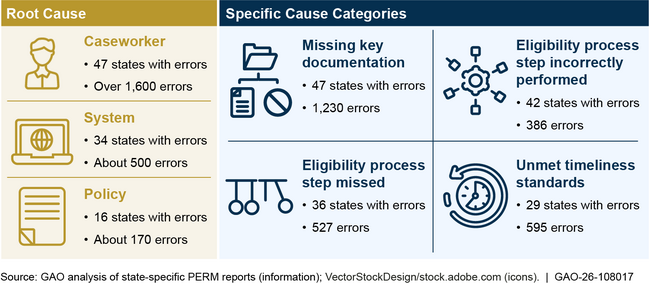
Note: Error totals may not match as some causes are not listed. See report for more information.
The selected states GAO reviewed took a variety of corrective actions—such as providing caseworkers with training, guidance, and making updates to eligibility systems—to reduce eligibility errors identified in the PERM and MEQC. Although CMS provides feedback on states’ CAPs, the agency’s inconsistent enforcement of required evaluations and limited analysis of state CAPs impair its oversight:
- Incomplete CAPs. CMS accepted PERM CAPs that were missing elements required by federal regulations. For example, states are required to evaluate the effectiveness of their prior corrective actions across five elements, but many CAPs GAO reviewed were missing required elements.
- Limited analyses of CAPs. CMS does not systematically analyze eligibility errors and CAPs across states and years to determine the effectiveness of corrective actions and whether they could be effective in multiple states.
Collecting required elements and conducting these analyses would help CMS better support states in reducing eligibility errors and improper payments.
Why GAO Did This Study
Determining Medicaid eligibility is a complex process that is vulnerable to errors and can lead to improper payments. CMS oversees Medicaid eligibility determinations through its PERM program, which is conducted across all states on a 17-state, 3-year rotational cycle. CMS also requires states to conduct reviews of both eligibility approvals and denials through the MEQC program. The PERM national estimate of improper payments due to eligibility errors has fluctuated in recent years, in part due to temporary changes in Medicaid eligibility requirements implemented in response to the COVID-19 pandemic, but has recently begun to increase. GAO was asked to review Medicaid eligibility errors. This report describes the causes of Medicaid eligibility errors and corrective actions selected states took to address them, and assesses CMS’s oversight of state corrective actions. GAO reviewed state-specific PERM reports and other documentation from CMS for reporting years 2019 through 2025, as well as MEQC results and CAPs from seven states selected to obtain variation in Medicaid expenditures, enrollment, and eligibility error rates. GAO also interviewed officials from CMS and those states.
Recommendations
GAO is making two recommendations to CMS to (1) ensure PERM CAPs include all required elements, and (2) systematically analyze eligibility errors and corrective actions across states and years and use that information to reduce errors. The agency agreed with the second and asked that the first be closed, stating its routine oversight process is sufficient. GAO maintains that additional action is needed as CMS has accepted incomplete CAPs.
Recommendations for Executive Action
| Agency Affected | Recommendation | Status |
|---|---|---|
| Centers for Medicare & Medicaid Services | The Administrator of CMS should ensure that states' PERM CAPs include all required elements before accepting them. (Recommendation 1) | Open When we confirm what actions the agency has taken in response to this recommendation, we will provide updated information. |
| Centers for Medicare & Medicaid Services | The Administrator of CMS should systematically analyze PERM and MEQC eligibility error results and associated corrective actions across states and across reporting years to assess the effectiveness of those corrective actions and use that information to help states reduce eligibility errors. (Recommendation 2) | Open When we confirm what actions the agency has taken in response to this recommendation, we will provide updated information. |